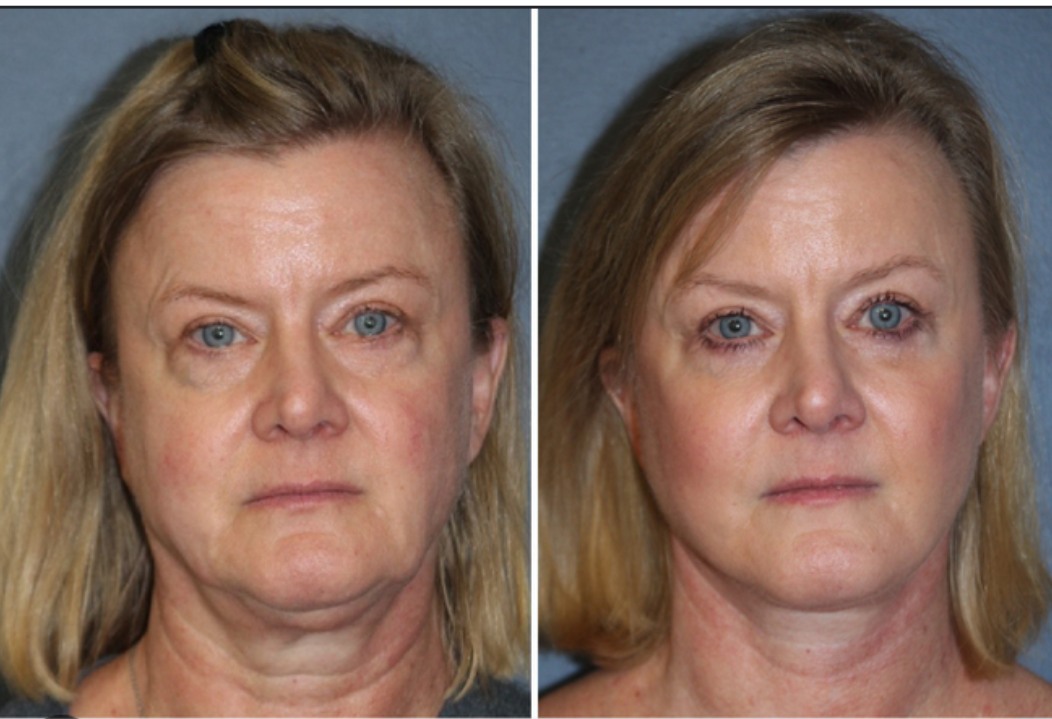
You look in the mirror and you see it — the jaw has softened, the neck has lost its sharp angle, and there’s a heaviness along the lower face that no amount of skincare can address. You’re not alone, and more importantly, you’re not out of options. The real question isn’t whether to do something — it’s knowing which procedure actually addresses your specific anatomy.
Not every sagging jawline needs a full facelift. Not every neck concern requires surgery. And confusingly, procedures with similar names — mini facelift, liquid facelift, chin lift, neck lift — address very different anatomy and produce very different results. This guide cuts through the noise so you can walk into your consultation already informed.
Understanding Facial Ageing: Why the Lower Face Changes First
Facial ageing is not simply skin getting looser. It’s a combination of processes happening simultaneously: the skin loses collagen and elasticity, the underlying fat compartments deflate and descend, the facial bones subtly resorb, and the muscles that once held everything taut begin to elongate under decades of gravity and repeated expression.
The lower face — the jawline, jowls, and neck — is typically where these changes become most visible first. The result is a predictable pattern:
- The skin of the cheek descends, creating heaviness along the jawline and early jowling
- The angle between the chin and neck softens, reducing the jaw-to-neck definition
- Excess skin and fat accumulate in the neck, forming bands, fullness, or a “turkey neck” appearance
- The chin can appear to recede as surrounding tissues descend, even if the chin itself hasn’t changed
- The transition from face to neck loses sharpness, making the entire lower face look heavier
Understanding this cascade matters because different procedures address different parts of it. A mini facelift addresses early jowling and lower face laxity. A neck lift addresses the neck specifically. A chin augmentation addresses the chin-to-neck ratio. Choosing the right intervention depends entirely on which of these is driving the change you see.
The Four Main Procedures: Explained Simply
“The most common mistake I see is patients who come in asking for one procedure when their anatomy would actually respond better to a different one. The consultation is where we identify what’s driving the change you see — and match the solution to that, not to the name.” — Dr. LeVeen, F.A.C.S., RejuveenMD Palo Alto
Side-by-Side: Which Procedure Does What
The table below compares the four approaches across the most common patient concerns. Use this as an orientation guide — anatomy always determines the real answer.
| Concern | Mini Facelift | Liquid Facelift | Chin Lift | Neck Lift |
|---|---|---|---|---|
| Jowling / jaw laxity | ✓ Best | Mild only | No | Partial |
| Neck bands (platysma) | No | No | No | ✓ Best |
| Neck skin laxity | Partial | No | No | ✓ Best |
| Volume loss / hollowing | No | ✓ Best | Partial | No |
| Weak / recessed chin | No | Temp. filler | ✓ Best | No |
| Submental fat | Partial | No | Partial | ✓ With lipo |
| No downtime required | No | ✓ Yes | No | No |
| Long-term permanence | 7–10 yrs | 12–18 mo | Permanent | 7–10 yrs |
← swipe to see all columns →
Which Procedure Is Right For You?
Rather than starting with a procedure name, the better starting point is your primary concern. The guide below maps the most common patient presentations to the surgical approach Dr. LeVeen typically recommends.
The Mini Facelift: What It Actually Does
The mini facelift — sometimes called a short-scar facelift or S-lift — is one of the most requested procedures at RejuveenMD, and one of the most misunderstood. Patients often assume it is a watered-down version of a full facelift. It isn’t. It is a precisely targeted procedure for a specific anatomy: patients in their 40s and 50s with early jowling, moderate lower face laxity, and a neck that is still relatively well-supported.
The key difference from a full facelift is incision length and the depth of correction. A mini facelift uses smaller incisions (typically concealed within the hairline and around the ear), does not reposition the deeper SMAS layer as extensively, and does not address the neck directly. This makes recovery faster — most patients return to normal activity within 2–3 weeks — and results are natural rather than “pulled.”
- Best candidates: 40s–50s, early to moderate jowling, good skin elasticity, relatively firm neck
- Incisions: short scars within the hairline and around the ear, not visible in normal social situations
- What it corrects: jowling, lower face laxity, softened jawline definition
- What it does not correct: significant neck banding, deep midface descent, or significant volume loss
- Recovery: 10–14 days of social downtime, return to light activity at 2–3 weeks
- Longevity: 7–10 years depending on individual ageing rate and lifestyle
The Neck Lift: When the Neck Is the Priority
A neck lift (lower rhytidectomy) is the only procedure that reliably corrects the full range of neck ageing concerns.
Platysmal banding: The visible vertical cords that appear on the front of the neck. These are the edges of the platysma muscle, which separates with age. A neck lift includes a platysmaplasty — suturing the muscle back together under the chin to restore a smooth neck contour.
Neck skin laxity: Loose, hanging neck skin that no cream or device can tighten. Surgical excision of excess skin produces the only reliable correction. Dr. LeVeen places the incision around and behind the ear, where it is concealed by the natural contour.
Submental fat: A neck lift is frequently combined with submental liposuction — precisely removing fat beneath the chin to sharpen the jaw-to-neck transition.
The Chin’s Role: Why It’s Often the Missing Piece
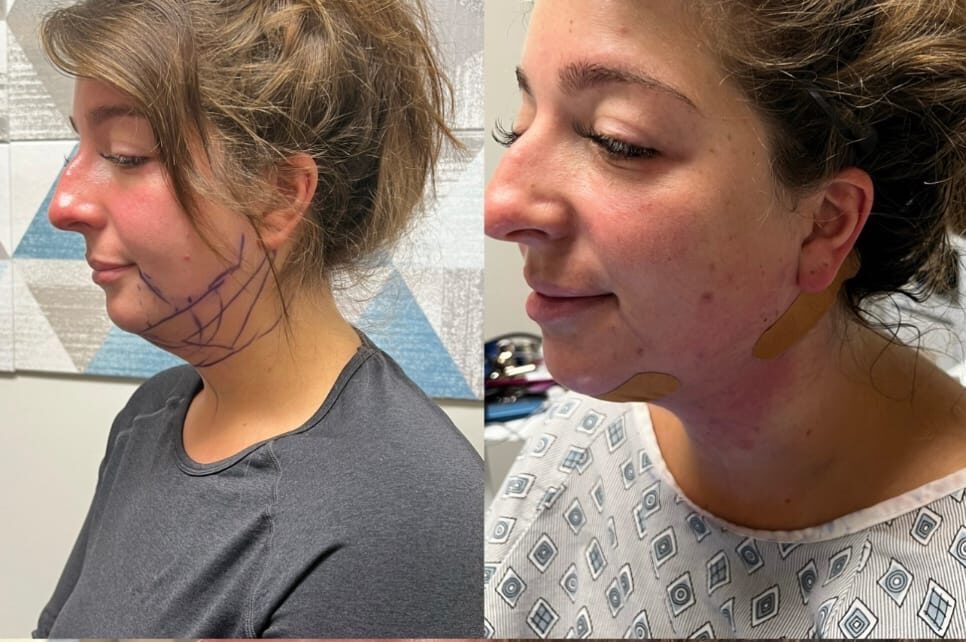
Of all the lower face structures, the chin is the most frequently overlooked. A weak or retruded chin shortens the visual chin-to-neck distance, blunts the cervicomental angle (the sharp angle below the chin), and makes the neck appear heavier than it actually is.
In consultations, Dr. LeVeen routinely identifies patients who attribute their dissatisfaction to the neck or jawline, when digital simulation reveals the primary driver is actually chin projection. Chin augmentation with a silicone implant — or chin filler as a non-surgical trial — is one of the highest-impact, quickest-recovery interventions in lower face rejuvenation.
“A well-projected chin is like a strong foundation for the lower face. When it’s there, the neck looks sharper, the jaw looks cleaner, and the whole face appears more balanced — without touching anything else.” — Dr. LeVeen, F.A.C.S., RejuveenMD Palo Alto
The Liquid Facelift: Who It’s Actually For
The liquid facelift uses injectable dermal fillers and neuromodulators (Botox®, Dysport®) to create a lifting, volumising, and smoothing effect without incisions.
What a liquid facelift does well: Restoring volume to deflated cheeks and temples, softening nasolabial folds, defining the jawline with strategic filler placement, and relaxing overactive muscles that contribute to brow depression and lip lines. For patients in their late 30s and early 40s with volume loss as the primary concern and minimal tissue laxity, results can be genuinely striking.
What a liquid facelift cannot do: It cannot lift descended tissue, tighten loose skin, correct platysmal neck bands, or address true jowling. An honest consultation will clearly delineate whether your concern is volume loss (liquid facelift) or tissue descent (surgical lift).
Combination Procedures: When One Isn’t Enough
In practice, the most satisfying facial rejuvenation results often come from combining two or more procedures in a single surgical session.
- Mini Facelift + Neck Lift: The most comprehensive lower face restoration — addressing jowls, jawline, neck skin, and muscle banding in one recovery. Typically recommended for patients 50–65 with both concerns present.
- Neck Lift + Submental Liposuction: The combination that produces the sharpest chin-to-neck angle, removing fat while lifting and tightening the overlying skin simultaneously.
- Mini Facelift + Chin Augmentation: Lifts the lower face while projecting the chin — a powerful combination for patients with both laxity and a recessed chin.
- Surgical Procedure + Liquid Facelift: Surgery addresses laxity; fillers address volume loss. Staged together, they achieve comprehensive rejuvenation that neither can produce alone.
Recovery: What to Realistically Expect
The following reflects Dr. LeVeen’s typical patient experience, not best-case scenarios.
| Milestone | Mini Facelift | Neck Lift | Chin Augmentation |
|---|---|---|---|
| Return to desk work | 7–10 days | 7–10 days | 5–7 days |
| Presentable socially | 10–14 days | 10–14 days | 7–10 days |
| Light exercise | 3 weeks | 3 weeks | 2 weeks |
| Full exercise | 5–6 weeks | 5–6 weeks | 4 weeks |
| Swelling largely resolved | 6–8 weeks | 6–8 weeks | 4–6 weeks |
| Final result visible | 3–6 months | 3–6 months | 2–3 months |
← swipe to see all columns →
A compression garment is worn for 1–2 weeks following neck lift and facelift procedures. Dr. LeVeen provides a detailed, personalised written recovery protocol at your pre-operative appointment.
Your Consultation: What to Expect
Your consultation at RejuveenMD is an assessment, not a sales appointment. Dr. LeVeen will examine your facial anatomy in detail — skin quality, tissue laxity, muscle activity, bone structure, and fat distribution — and tell you honestly which procedures would and would not make a meaningful difference for your specific face.
- Photos of yourself from 10–15 years ago — these help Dr. LeVeen understand your personal ageing pattern and set realistic goals
- Reference photos showing results you admire (realistic, natural-looking results from real patients)
- A list of your primary concerns in order of priority
- Full medication and supplement list, including blood thinners, vitamin E, and fish oil
- Any questions about scarring, downtime, anaesthesia, or cost — no question is too small
Consultations are available in-office at our Palo Alto location, by phone, or virtually. Call +1 (650) 600-9838 or book online.